Aerospace

In the aerospace field, some components' foam sandwich structures have replaced the honeycomb sandwich structures and have become one of the means to reduce weight and enhance strength of aircraft. After undergoing appropriate high-temperature treatment, PMI foam can meet the high-temperature requirements of the composite material curing process, thus enabling PMI foam to be widely applied in the aerospace field.
The PMI foam has higher specific strength and specific modulus, and is isotropic. Even at the edges of the foam, it can effectively support the layers from all angles, providing sufficient counter-pressure, resulting in a dense and smooth cured skin layer. This can significantly reduce the weight of the propeller, simplify the design and process. Additionally, due to the high working temperature of PMI foam (up to 200℃) and the small temperature-induced compression creep, it can adapt to medium and high-temperature resin curing processes, thereby shortening the production cycle, improving the product performance, and enhancing the shock absorption effect.
CK52 and CK72 in Zihacell® medium-temperature PMI foam are suitable as core materials for helicopter rotor blades/tail rotor blades; CK110 in Zihacell® medium-temperature PMI foam is suitable for rocket compartments and fairings.
Radar Antenna

In radar antenna systems, PMI foam has good electromagnetic wave penetration characteristics in electrical performance and can withstand harsh external environments in mechanical performance. In addition to providing necessary strength and stiffness, PMI foam can greatly reduce transmission loss due to its low dielectric constant and dielectric loss tangent.
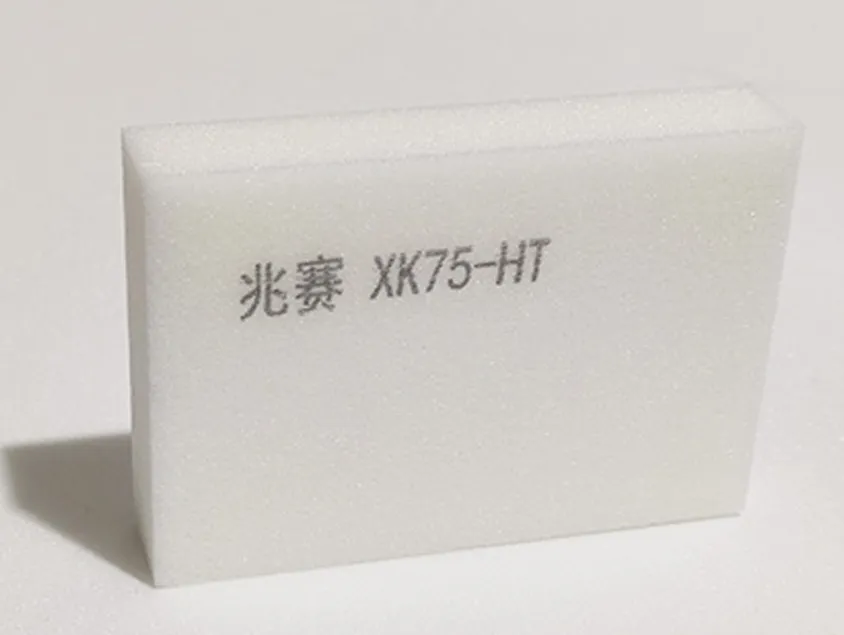
XK52, XK75, and XK110 in Zihacell® medium-temperature PMI foam are suitable for radar, radome, and internal support components of radar and antenna.
UAV

PMI foam has high specific strength, high specific modulus, and low resin absorption rate. When used as a core material with carbon fiber composite materials to make wing panels, it not only simplifies the molding process but also results in higher overall strength, lighter weight, and improved reliability and durability of the aircraft.
Several advantages of using composite materials instead of metal materials in UAV manufacturing:
1. Reduce fuselage weight and improve endurance;
2. Reduce vibration and noise, and improve overall impact resistance;
3. Reduce signal interference from metal materials to remote signals;
4. Simplify molding processes and improve flexibility in product structural design.
Using PMI foam and other materials as core materials with carbon fiber composite materials to make wing panels can eliminate a large number of beam and rib structures, further simplifying the production process. Due to the high specific strength, high specific modulus, and low resin absorption rate of PMI foam, the overall strength of the wing panel is higher and the weight is lighter.
XK32, XK52, and XK75 in Zihacell® medium-temperature PMI foam are suitable as sandwich materials for UAV wings;
Automobile Manufacturing

The lightweight development of automobiles can be achieved by combining PMI foam with other materials through certain processing techniques, which can easily realize the modularization of design and manufacturing to achieve the best combination of functions of materials and parts used. It is applied in fields such as design, production process, assembly, and connection to improve power performance and reduce maintenance frequency.
XK52, XK75, and XK110 in Zihacell® medium-temperature PMI foam are suitable as sandwich materials for automotive interiors, spoilers, racing car body panels, floors, and diffusers.
Rail Transit
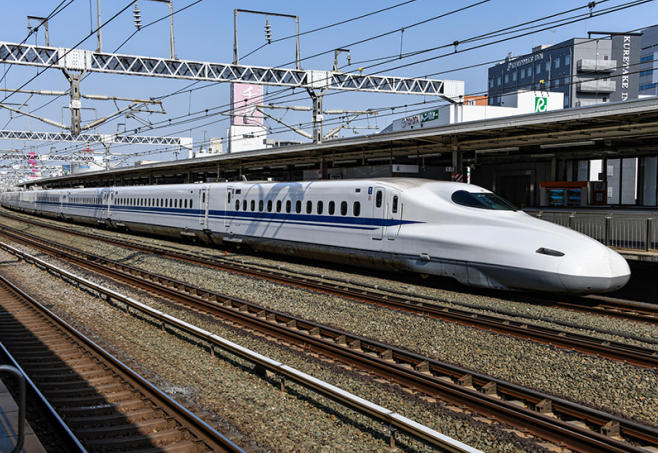
PMI foam sandwich material combined with aluminum alloy skin and profiles forms a skeleton-type sandwich structure, which can be applied to parts such as the side wall, roof, and side roof of maglev vehicle bodies, achieving significant lightweighting and simplified installation.
XK52 and XK75 in Zihacell® medium-temperature PMI foam are suitable as sandwich materials for train interiors and wall panels.
Vessel and yacht

PMI foam is usually used in deck and bulkhead structures as a composite sandwich structure, which can save a lot of fuel, not deform, and not absorb water. After decades of verification in multiple countries, PMI foam has become the preferred material for ship thermal insulation and sound insulation. PMI is used in noise reduction laminates and sound-absorbing ceilings to ensure the safety and quality of life of public personnel on board. It is used in fire-resistant partitions, such as ship thermal insulation laminates, high-temperature pipelines, cabin linings, ceilings, decks, and cold storage ships, where the consumption of interior insulation materials is very large.
The density of fiber insulation materials is generally 100kg/m3. If PMI replaces traditional inorganic fiber insulation materials, a ship can reduce weight by about 500-850 tons. The increased carrying capacity brought by this weight reduction, coupled with the reliability of foam materials, will greatly improve ship performance and reduce operation and maintenance costs.
XK75 in Zihacell® medium-temperature PMI foam is suitable as a sandwich material in ship deck and bulkhead structures
Wind Power

Wind turbine blades are at the core of wind turbine design. Both PMI and PVC foams can provide excellent mechanical properties at low density, which can significantly reduce the weight of composite materials and reduce loads when the blades are longer.
Compared with other core materials, PMI foam can provide excellent mechanical properties at low density, which can significantly reduce the weight of composite materials, and due to its good cell size, the resin adsorption amount is relatively small.
Sports Equipment

Composites composed of glass/carbon fiber and high-performance foam are becoming increasingly important for modern sports equipment. Through the application of heat and pressure, high-strength PMI foam can be combined with them to form extremely durable composite materials. The ability to obtain complex geometric shape components through thermoforming or CNC also makes large-scale production possible. These composites are very suitable for manufacturing sports equipment such as racing wheels, rackets, hockey sticks, skis, and surfboards.
Medical Devices
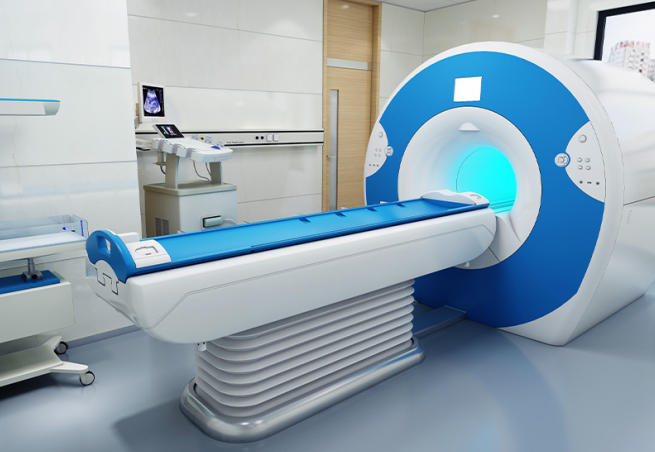
Traditional medical bed boards are mostly made of materials such as phenolic resin boards and aluminum plates. They have poor mechanical properties, low radiation transmittance, and insufficient imaging clarity. Compared with traditional medical bed boards, carbon fiber reinforced composite materials have the advantages of high elastic modulus, high strength coefficient, and extended instrument lifespan. What's more, the absorption coefficient of X-ray quality for carbon fiber composite materials is very low, much lower than that of common materials. Therefore, carbon fiber composite medical bed boards have high X-ray radiation transmittance, which can reduce the radiation harm to patients from X-rays.
If the structure of carbon fiber and PMI foam is applied, the X-ray transmission performance is better than that of traditional medical materials such as phenolic resin boards and aluminum plates. Moreover, carbon fiber composite materials allow X-rays to be irradiated on the bed board at any angle without causing refraction. The application of PMI foam can also significantly improve the bearing capacity of the component: the carbon fiber sandwich structure component made of PMI foam as the core can withstand a load of up to 1200kg, while ordinary supports can only withstand a load of 400kg.
Audio Speakers
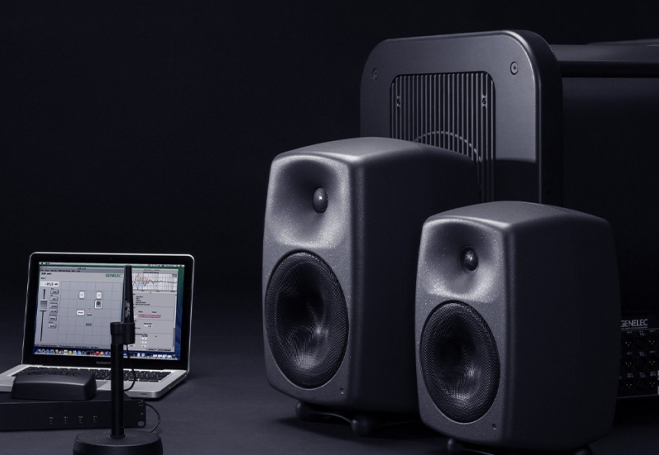
Previously, speaker diaphragms were made of pulp, wood chips, or traditional MCPET/PP foam plastic plates. The composition of the pulp, such as the type and length of fibers, and the composition of fillers, as well as the papermaking process and post-treatment methods (such as air drying or hot pressing), will affect the final product and sound characteristics. The sound characteristics of paper cones are smooth and natural, bright and clear.
In addition, as mobile phones become thinner and thinner, higher requirements are put forward for diaphragm materials in terms of thinness, uniformity, temperature resistance, and rigidity.
PMI foam is formed by free expansion foaming at a high temperature of over 220℃, and its long-term temperature resistance can reach over 180℃. Even after cutting to a minimum thickness of 0.08mm, it can still maintain stable performance. The diaphragm made of PMI foam with skin materials such as carbon fiber and aluminum foil can produce crisp and pleasant sound across the entire frequency range when vibrating at different frequencies.
Float Body
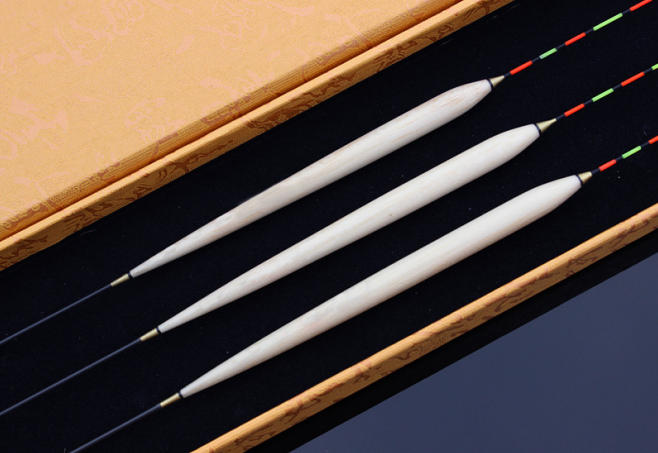
Advantages of PMI floats:
1. High buoyancy ratio;
2. Low material water absorption;
3. Uniform and stable material density;
4. Strong and durable material;
5. High plasticity;
6. Low raw material cost, rapid molding, high yield, very suitable for industrial production.
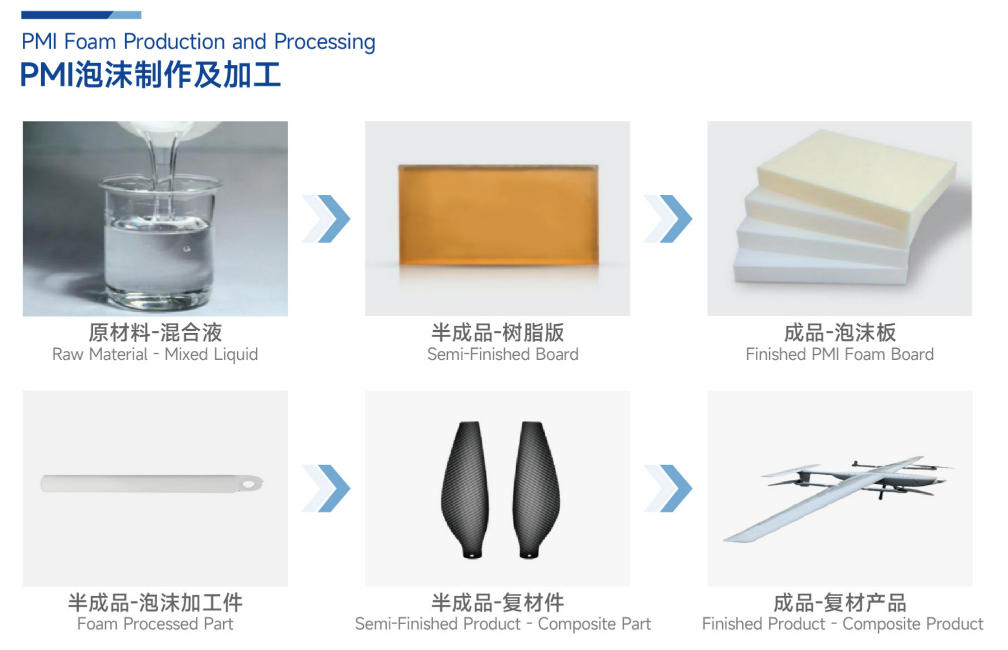
PMI Foam Manufacturing and Processing
 EN
EN
 jp
jp  ko
ko  fr
fr  de
de  es
es  it
it  ru
ru  pt
pt  ar
ar  tr
tr